
Conventional gravity sewer has a fundamental constraint: it needs to flow
downhill. That sounds simple enough until you're looking at a lakefront community
where the homes are scattered across rocky terrain, a coastal town where the
ground is essentially flat and the water table is six inches below the surface,
or a hillside subdivision where the elevation changes 200 feet from one end of
the street to the other.
In situations like these, engineers have two choices: spend a significant amount
of money on lift stations, deep-bore tunneling, and specialized construction to
make gravity sewer work anyway — or use a system that was designed from the
ground up to not need gravity at all.
That second option is what E/One calls ALL-TERRAIN SEWER®.
The Core Concept
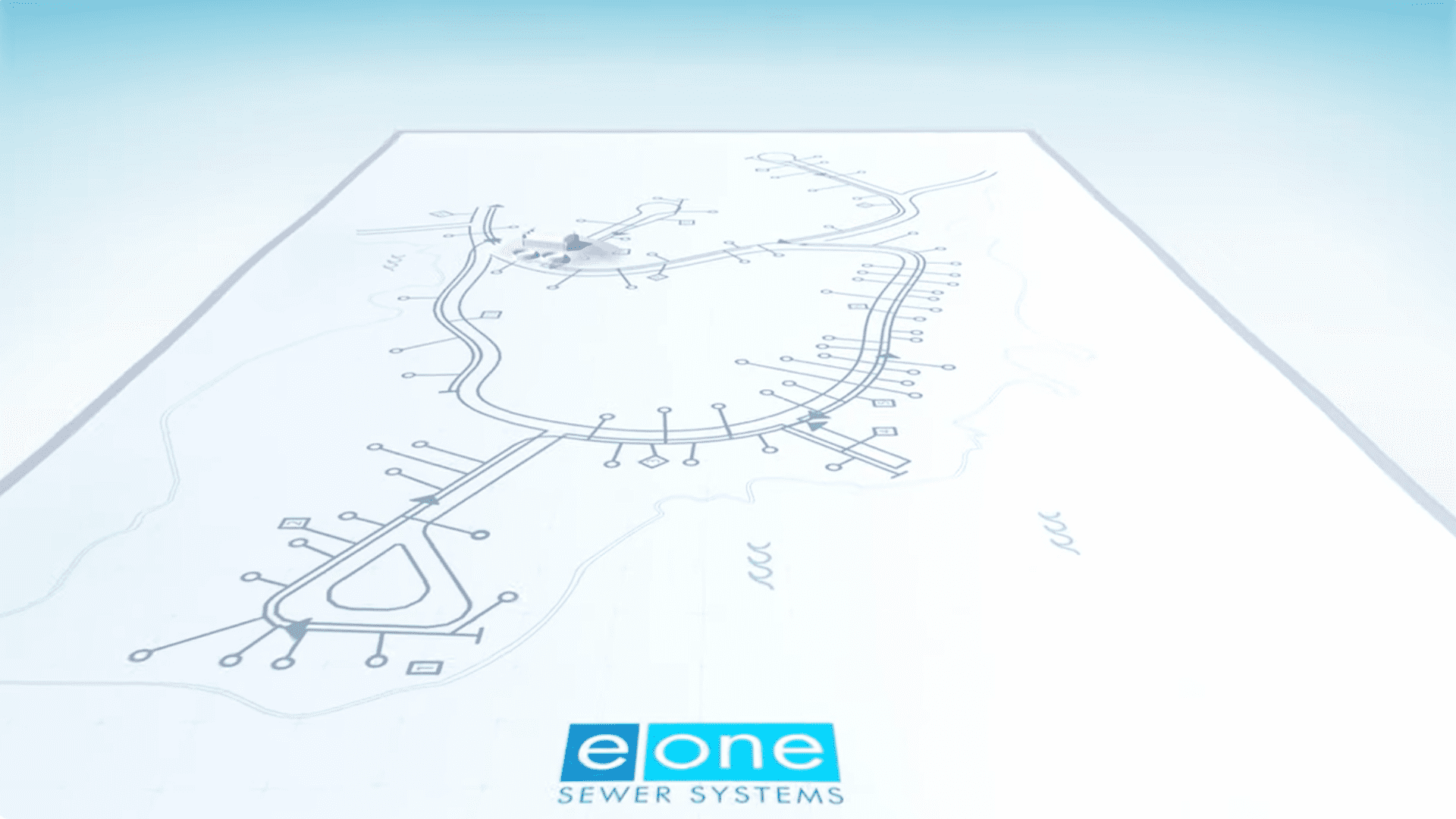
ALL-TERRAIN SEWER® is E/One's branded name for a low-pressure grinder pump sewer
system. Instead of collecting wastewater in large-diameter gravity mains that
must be sloped toward a treatment facility, each property in an ALL-TERRAIN SEWER
system has its own individual grinder pump station. The pump grinds solids and
then pushes the resulting slurry under pressure through a small-diameter (1.25"
to 2") service lateral to a shared pressure main.
Because the system is pressurized, the main can run uphill, downhill, around
obstacles, and through tight corridors. Pipe burial depth is driven by frost line
and cover requirements — not by the need to maintain a specific slope. That means
significantly less excavation, shorter construction timelines, and far less
disruption to existing landscaping, pavement, and structures.
Cost Comparison: Pressure Sewer vs. Gravity Sewer
E/One frequently cites the figure that their systems can be installed at up to
half the cost of conventional gravity sewer. That claim holds most strongly in
challenging terrain — which is, of course, exactly where ALL-TERRAIN SEWER is
most likely to be specified.
The savings come from several sources:
- Smaller pipe diameter (2" vs. 8"–12" or larger for gravity)
- Shallower, narrower trenches
- Elimination of large lift stations in many applications
- Shorter overall construction timelines
- Less pavement removal and restoration For lakefront and waterfront projects, there's an additional factor: small- diameter pressure mains can often be installed with directional boring rather than open trenching, which is a significant advantage when you're working around tree roots, sensitive shoreline habitat, or existing infrastructure. E/One also offers a Life Cycle Cost Calculator on their website (eone.com) that allows engineers to compare total costs — capital, operations, and maintenance — between pressure sewer and gravity alternatives for a specific project.
Real-World Applications
The E/One case study library reads like a tour of America's most challenging
sewer projects. A few examples that illustrate the range of the ALL-TERRAIN SEWER
system:
- Fallingwater, Pennsylvania — The Frank Lloyd Wright landmark at the edge of Ohiopyle State Park is connected to an E/One system that navigated the rugged terrain of the Youghiogheny River gorge without disturbing the site.
- Florida Keys — Low elevation, high water table, coral substrate, and environmentally sensitive marine habitat made conventional sewer impossible. E/One's pressure sewer system connected thousands of properties that had relied on septic systems or cesspools.
- Kohanaiki, Hawaii — A high-end resort community on lava rock. There is arguably no terrain harder to trench through than solidified lava. E/One's system was the engineering solution.
- Flathead Lake, Bigfork, Montana — A deteriorating gravity system on challenging waterfront terrain was replaced with E/One pressure sewer, reducing maintenance demands and protecting the lake from septic contamination.
Is ALL-TERRAIN SEWER Right for Your Project?
If you're an engineer, municipal utility director, or developer evaluating sewer
options for a site with challenging terrain, low lot density, a high water table,
or proximity to sensitive water bodies, E/One's ALL-TERRAIN SEWER system is worth
a serious look.
Haynes Equipment can connect you with E/One application engineering resources,
help you source equipment, and support your project through installation and
long-term service. Contact us to discuss your project.